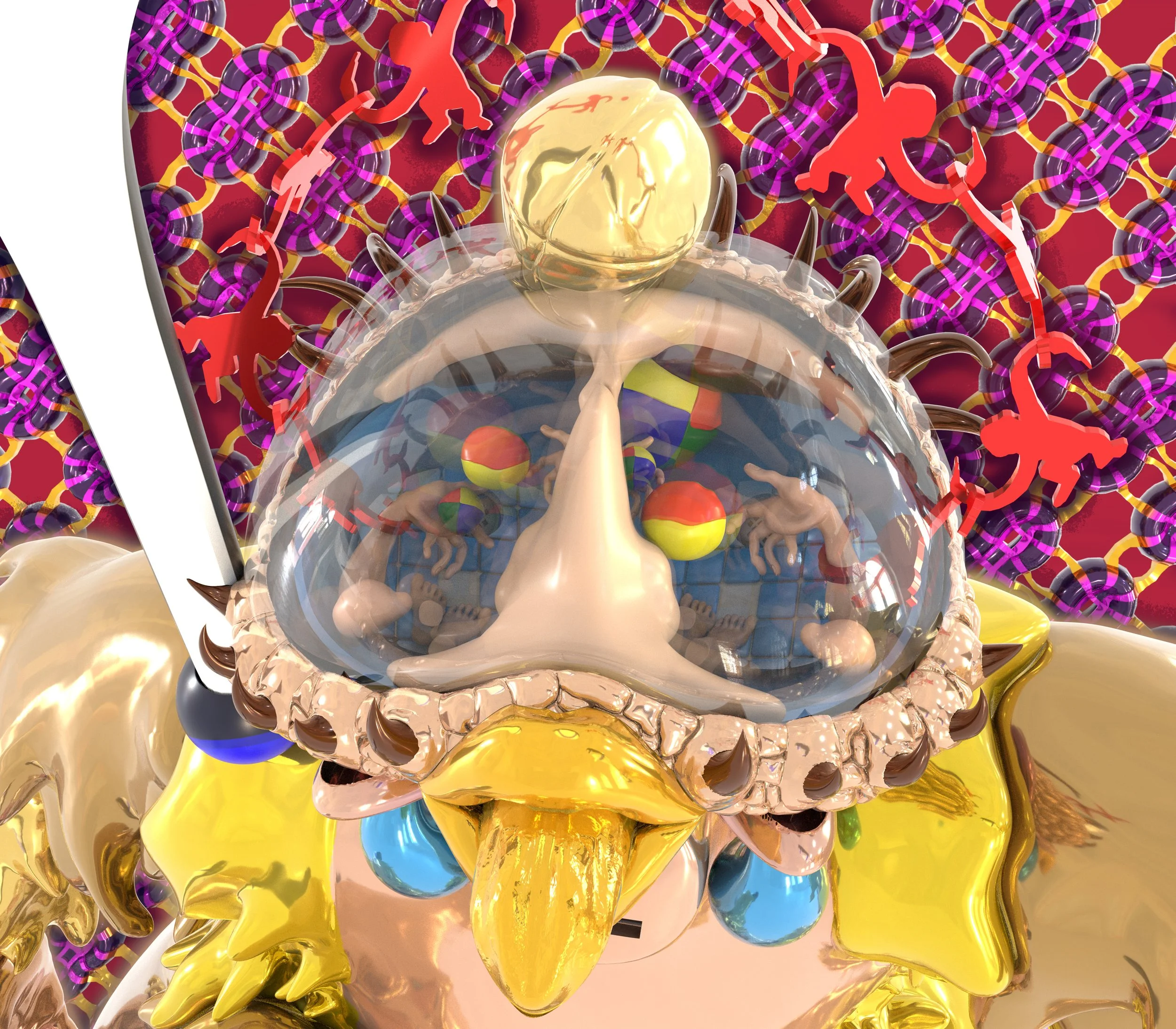
The peripersonal space of an observer is embedded in a bubble while he looks cross-eyed at the bridge of his nose, and juggles in a shower.
From the frontal view, objects appear in accordance with standard linear perspective. From an oblique vantage, however, functional groups within actionable distance are arranged along the depth axis according to an attentional hierarchy, wherein spatial location becomes secondary. Take note: the ball striking the juggler’s eyebrow drops out of the plane of the remaining cascade.
We Feel We All Are Me - And Feel Our Me All See
Representing the visual experience as an object may be impossible precisely because it is too highly dimensioned to be expressed in the observable world. Since perception is a process, and not a thing, it can be of many more dimensions than the world of things it observes.
A fool’s errand, but an enticing one.
Don't Cross Your Eyes or They'll Get Stuck Like That
Ernst Mach set a visual convention with his drawing “Self-Portrait”, or “View from the Left Eye” which he produced to supplement his writing on perception in “The Analysis of Sensations” (1886). In the drawing, parts of Mach’s face are illustrated in an iconographic style as they appear positionally from the perspective of his left eye. The inclusion of Mach's facial anatomy within the foreground reveals a middle-man between the viewer of the drawing, and the depicted living room scene. This highlights an implicit aspect of all representational image making: you see now what I saw before.
The drawing presents an explicitly egocentric representation of human vision. True, Mach’s nose does exist within the same physical space as the couch, the window, and the trees seen beyond it; but, they can only appear in this relation from his subjective account. As Mach recounts, "My body differs from other human bodies [...] by the circumstance that it is only seen piecemeal, and, especially, is seen without a head.".
Mach’s novel drawing was limited to the view of a single eye, since “discussion of the binocular field of vision, with its peculiar stereoscopic features […] is not easy to describe, and cannot be represented by a single plane drawing.”. Mach is concerned by the difficulty of depicting binocular summation, and an inability to graphically project reflex angles onto a flat 2D plane.
Both of these concerns are mitigated by crossing the eyes until they fixate on the bridge of the nose. In doing so, the image from each eye is entirely split, and the angle of visible space is sufficiently shortened to allow for projection to the plane without significant distortion.
Now, with our maneuverable space faithfully reproduced on a plane, what will we make of our remaining third dimension?
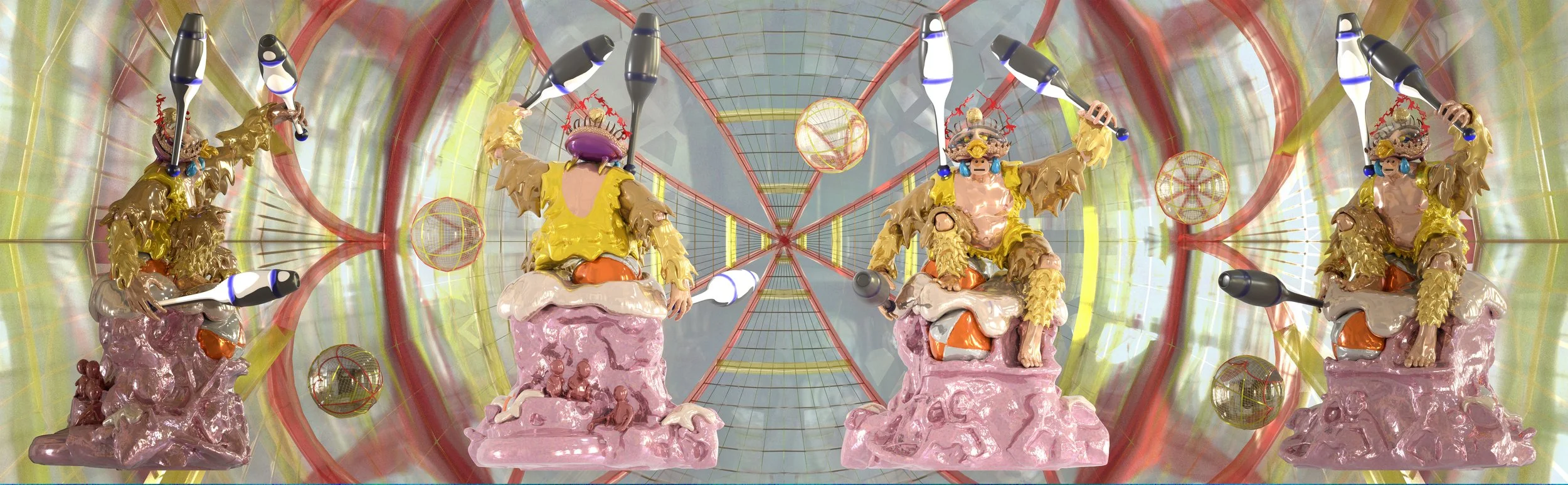
WFWAAM AFOMAS in the round. Rendered as mirror finished steel with transparent colored tint.